
There is a new methodology of control in U.S. schools, and it goes by many names. It can be elusive and, insidiously, it clothes itself in child-centric language. “Skill-building,” “student-centered learning,” and “strengths-based assessment” are a few of its known aliases. It claims to put students first and be concerned with students’ holistic personal development. However, the loyalties of this new school of thought do not belong to students.
In the time I’ve spent learning about U.S. education, first as a student in public schools and later as a graduate student and school psychologist, I’ve witnessed shifts in what makes a successful student. I attended high school way back when the SAT and ACT were essentially a de facto requirement of college applications. Since the pandemic, this policy has shifted, even among top universities, to a “test-optional” approach or even one of “test-blindness”. The reduced focus on the big standard aptitude tests—which I’ve written in a previous essay are as reliably representative of the socio-economic status of one’s family as of a test-taker’s intellectual abilities—has augmented the importance of extracurricular activity involvement and academic success in college applications. While you’ll hear no argument from me in support of the SAT, extracurricular activities and academic achievement as measurements of college readiness are problematic in their own right. For one, involvement in resume-enhancing extracurricular activities is dependent on one’s access to extracurricular programs—access that is deeply dependent on socio-economic status. A large part of someone’s ability to invest time in extracurriculars involves the absence of responsibilities at home that would limit their available time, e.g. taking care of younger siblings, cooking, or working to help support their family. At first glance, academic achievement as measured by grades provides the most convincingly unbiased method for assessing college readiness (and legitimating the myth of merit in college admissions). After all, cognitive scores are the single best predictor of grade-point average1. However, multiple studies have attested to the centrality of specific personality traits to academic achievement2—personality traits that are eerily in-line with those that make a good employee. In particular, students’ display of personality traits like “Punctual,” “Perseverant,” “Externally Motivated,” “Consistent,” “Predictable,” “Empathizes Orders,” “Defers Gratification,” and “Dependable” is significantly correlated with higher grade-point averages. In contrast, the expression of “Independent,” “Aggressive,” and “Creative” traits have been shown to be negatively associated with academic success.
While we would love to think of our methodologies for evaluating students in schools as impartial, the structural nature of U.S. schools as centers of class reproduction ensures that the metrics we use to evaluate students will be informed by the perspectives of employers, not the best interests of students and families. Low-income public schools and community colleges focus on teaching working-class students how to be productive on the job, while private academies and prestigious universities prepare children of the ruling class to manage and lead. The evaluation regimes at these two particular types of institutions reflect those objectives: in public schools, obedience, consistency, rule-following, and hard work are highly valued just as initiative, inventiveness, independence, and creativity are rewarded at exclusive private schools and elite universities. When new evaluation regimes come about that do not attempt to undermine these structural objectives and the economic structures which determine them, we’d do well to be skeptical about claims that these new systems put the students first.
The Strengths-Based Assessment Model
The identifying characteristic of “strengths-based” or “student-centered” models is their emphasis on the assessment and cultivation of specific personal skills, as opposed to straightforward achievement on aptitude tests (think cognitive-heavy aptitude tests like the SAT). While these paradigms are not (perhaps yet) employed in place of grades, they are increasingly incorporated into grading procedures by separating grades into “process” and “product” components. Their approaches are presently used to problem-solve for students who are struggling academically and behaviorally, and their language is used to frame discussions of whole-school approaches to student success. In the summary statement of Patricia Noonan and Amy Gaumer Erickson’s 2018 book The Skills That Matter: Teaching Interpersonal and Intrapersonal Competencies in Any Classroom, the authors paint a picture of skill-based assessment in the context of an evolving educational landscape:
Across the country, education efforts are shifting from a narrow focus on accountability and testing to a broader focus of better preparing students to be college and career ready. The trend of high academic expectations and measurement to the exclusion of all other skills is being displaced by discussions of meaning and relevance in rigorous academics, allowing an opportunity for innovation and creativity in how and what we teach students. [Emphasis added]
While this appears a magnanimous approach at first glance, the student-centered approach does precious little to free students from the model of impersonalized evaluation. In fact, the model still upholds the longstanding dual functions of the US education system: producer of labor power for a profit-oriented economy and scapegoat for the social ills that such an economy produces. The student-centered model accomplishes this, perhaps inadvertently from the perspective of progressive educators, by portraying qualities desirable for employers as college- and career-ready “life skills” that schools are helping students cultivate for themselves. The “student-centered,” “skills-based” paradigm is, at the end of the day, a new framework for justifying the administrative direction of student behavior and development toward the ends of a stable and profitable economic system.
To be clear: I want students to be successful too. Academic and behavioral success are fairly good outcomes for a student, and I would much rather have a student succeed academically than drop out. If I didn’t value academic success, I would be truly awful at my job. My gripe with this approach is that it claims to put students first while sneakily ensuring that at the end of the day, personal development on the part of students is directed toward their productive employment in a capitalist society.
An examination of the strategic choice of skills to include in discussion of “skill-based” approaches to education reveals some patterns. In a “Skills Wheel” adapted from The Skills That Matter and utilized by the Center for High School Success, educators are oriented toward four “high-leverage lifelong competency skills” to help “[9th-grade success] teams in identifying students’ skill-based strengths and barriers—particularly those that may be contributing to academic or behavioral challenges.”
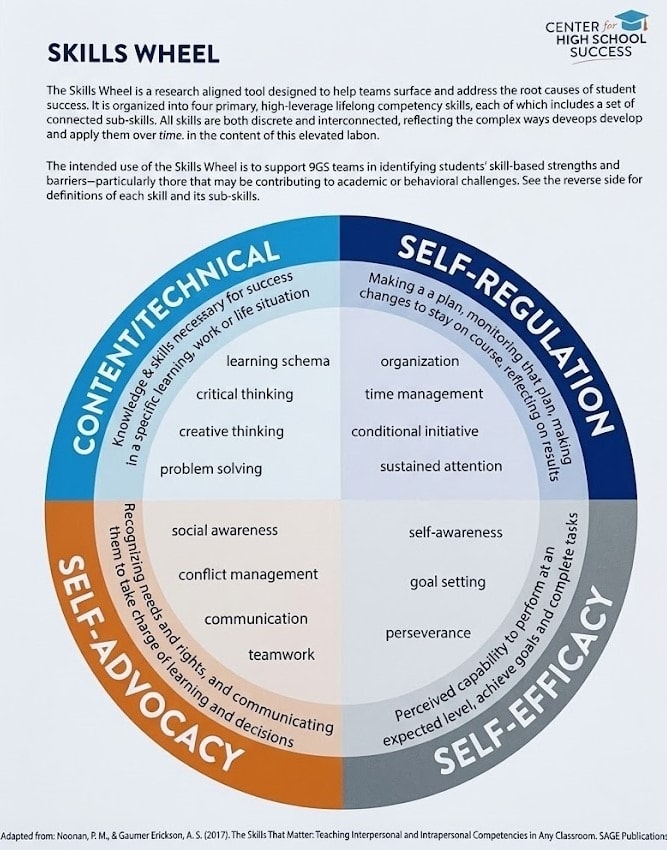
In this particular visual depiction of strengths-based education (of which there are many—just image-search “strength-based education” and you’ll be inundated with diagrams), it is fairly apparent that the four primary skill areas—Self-Efficacy, Self-Advocacy, Self-Regulation, and Content/Technical—are deeply informed by productivity and job performance. In addition, the four highlighted skill areas have next to nothing to do with personal wellbeing—that is, the type of wellbeing that is distinct from effective occupation in capitalist production. Note the lack of consideration for traits not immediately translatable to productivity—compassion, empathy, consideration, passion, moral thinking, calmness, etc.—or the presence of any value system which extends beyond simple “achievement” in the school or workplace context. Every single skill in this skill wheel is one that describes the dream employee of a capitalist employer. Critical and Creative Thinking are the two traits most likely to be problematic to the stability of the capitalist enterprise, but even then the inclusion of these two traits is hedged by the narrow specificity of their proposed application: “a specific learning, work, or life situation.” Not the type of critical or creative thinking used in open-ended contemplation, and definitely not the type conducive to the restructuring of political or organizational arrangements.
Student-centric language serves the function of responding to the mountains of criticism which accuses the US school system of not serving its students, but rather the social control and labor production needs of a corporate capitalist economy. Reframing the language of assessment from a focus on performance and academic accountability to individual skill-based strengths, while maintaining the unpopular objective of the much-maligned accountability era—the preparation of students for the labor market—allows its proponents to retain the image of Progressive politics while continuing to dutifully serve the interests of capitalist accumulation. This is a clever frame: describing classroom behavior or academic failure in terms of a student’s skills, rather than their outright compliance with directives (or their general intelligence), makes it difficult to argue that an intervention is not in a child’s best interest, even if the underlying reasons for evaluation and intervention have remained the same.
A Brief History of Social Control and Economic Influence on U.S. Education
To illustrate the capitalist economy’s dependence on the education system for the creation of its workers as well as the evolving methods of social control that the education system has employed to do so, it is useful (and, I think, interesting) to describe a brief history of key moments of educational change.
From its inception, formal schooling in the US has primarily been about social control—in particular the type of social control which maintains a political landscape stable enough to accommodate capitalist production. This pattern of social control in service of political stability and the production of laborers is the pattern that emerges when you compare the form of capitalist production during a given time period and observe how its structure is reflected in the schoolhouses of the day.
The original common school movement emerged as the factory became the dominant form of production in the early 19th century. Forms of schooling such as dame schools and writing schools that mirrored the structure of the nuclear family—the prevailing unit of economic production at the time—were replaced by mass common education as formerly independent craftsmen were pushed out of self- or guild-employment and into factory labor by the consolidation of capital and the growing economic dominance of the factory. Leaders of industry began to see the structure and scale of education as it then existed as unsuitable for the continued production of a large number of skilled factory workers and poured resources into the promotion and proliferation of public common schools. These common schools, they thought, would more effectively ready children for the social relations of the factory, with bonus points if it tamed the rowdy and problematic elements of working class and immigrant families, giving their children some sorely needed discipline. The methods these schools used to instill a sense of discipline mirrored the often-brutal conditions of the factory itself. You may already have some idea of how this was done: paramilitary-style drill exercises and rote recital readied students for the repetitive and fragmented nature of factory work. Children were indoctrinated early into relations of strict hierarchical obedience to authority figures outside their immediate family and community in preparation for meek deference to their foremen and factory managers.
The common school movement, which actually saw strong opposition from many immigrant groups and grassroots movements of working-class people, was a smashing success as far as factory owners and high-status professionals were concerned. Common school enrollment ballooned in the early decades of the 19th century, and so did factory employment. It was no coincidence that the movement was politically bolstered and financially bankrolled by capitalist elites, and that the schoolhouses it produced adopted hierarchical authority structures based on non-familial skill and professionalism that were reminiscent of the factory, rather than the more informal familial authority structures of community esteem that had been commonplace in the decades preceding them.
The structure of the educational system continued to evolve over the following centuries in close coordination with the evolving form of capitalist production. When marginalized and oppressed groups of people (e.g. women, Black people) organized movements for economic freedom, a major part of the economic elite’s pacification strategy was greater incorporation of the given group into the labor market and increased inclusion in mainstream public schools. Inclusion in public schools usually served as a handy political device for the ruling elite—schooling is commonly conceived as the Great Equalizer and the ticket to economic opportunity for the enterprising young student. It is telling that wide-sweeping democratization in access to school for children of oppressed minority backgrounds in the mid-20th century did very little to affect the distribution of wealth across those same demographic lines3. The inclusion of oppressed classes into white public schools represented more of a concession by the predominately white capitalist ruling class to manage the behavior of minority children via inclusion and soft control instead of exclusion and forceful, violent control. They agreed to a policy of “equal opportunity”, at least in theory, on the condition that the economic class structures which created wildly unequal outcomes remained untouched.
As the factory method of production expanded ubiquity and sheer size, it became more difficult for employers to instill discipline into, and squeeze production out of, their workers through direct supervisory practices. Enter Frederick Winslow Taylor and the art of scientific management in the early 20th century, wherein control over the actions of workers was exerted by complex and rigid vertical stratification of authority over the production process. Vertical fragmentation of positions within the enterprise was supplemented by dividing the process of manufacturing into component tasks issued by explicit directives whose progress could be easily tracked and monitored, often down to the second. The Taylorist school of production and its business-oriented focus on efficiency was adopted wholeheartedly by increasingly centralized school districts whose school boards were overwhelmingly staffed by businesspeople and highly paid doctors and lawyers. Correspondingly, there was a massive increase in the number of school administrators—the educational equivalent of corporate middle management—many of whom worked out of central district offices. In line with the vertical fragmentation of work, the executive tiers of large, centralized school districts began to command long chains of cascading authority. In the school district in which I currently work, teachers are buried six layers of command deep, with the district superintendent presiding over the chain. This stands in stark contrast to the social conditions of work in schools during the initial common school movement, in which a schoolteacher usually reported to their principal, who acted more or less autonomously to administer to the immediate needs of the school, and who left decisions on classroom curriculum to the expertise of teachers.
In the classroom, scientific management practices called for the fragmentation of curriculum into discrete lessons and assignments, coupled with the close monitoring of academic performance—an analogue to the quantification of worker productivity in the workplace. Grades and standardized assessments were increasingly relied upon to rate, sort, and rank students according to their capacities in the classroom. Teachers retained direct authority over students, but control over students at the school level shifted away from the personal impressions and feedback of teachers and toward the indirect and highly systematized incentives and punishments of impersonal performance assessment.
In contemporary schools, business-oriented notions of productivity, achievement, and efficiency still abound. However, their mimetic form these days among school professionals, in my experience, tends to take a softer, more psychology- and mental health-informed frame. This individualistic self-care-coded focus is right in line with the self-supervision called for by contemporary corporate workplaces and the rhetoric of the gig economy, that everyone is a self-contained, self-regulated entrepreneur in a global marketplace.
On Executive Functioning
In most progressive school districts, like the one in which I work, educators typically respond warily, or even outright defensively, when allusions are made to the social control and wage-labor-readiness functions of schools. And understandably so: many of us are powerless to make profound systemic change on our own, and it’s painful to think, for a person who went into education to help children become the best versions of themselves, that the system they serve not only does not share their humanitarian values of personal development but is actively antagonistic to them. Nowadays, the new “meta,” if you will, among education professionals, is to avoid discussion of the personal development-suppressing nature of impartial evaluation and job preparation in schools by framing behavior control and management in the context of building individual skills ostensibly for the student’s benefit. IQ testing and the brutal and indifferent early 20th century sortation of students into select career paths that it facilitated has soured in popularity for good reason and has been replaced by testing for specific cognitive variables such as Processing Speed, Working Memory, and Fluid Reasoning. These cognitive skill measures are much more specific than “intelligence,” and less easily abused as notions of general worthiness as IQ. It follows that students who routinely stand out from the uniformity of acceptable conduct and scholastic achievement are often assessed, using rating scales such as the Conners and the Behavior Assessment System for Children (BASC), on such behavioral traits as Hyperactivity, Aggression, Impulsivity, Inattention, and Executive Functioning. It is the latter of these examples that is the focus of the remainder of this essay.
According to the BASC’s manual, Executive Functioning indices measure “the ability to control behavior by planning, anticipating, inhibiting, or maintaining goal-directed activity, and by reacting appropriately to environmental feedback in a purposeful, meaningful way.” In the school setting, this looks like directing attention to salient information, initiating tasks, independently minimizing distractions, tracking progress, and completing assigned work. Deficits in Executive Functioning are associated with psychopathologies like ADHD, Autism Spectrum Disorder, PTSD, and conduct disorders. A critical reader may have, from the aforementioned list of skills which make up an Executive Functioning index, noted that these skills are remarkably in line with a subordinate’s diligent and deferential response to the request of an authority figure. If that sounds like too big a stretch, it is useful to remember that Executive Functioning deficits are, in practice, identified in students who show difficulty following directives in school, not students who fail to initiate, persevere through, and ultimately finish personal pet projects outside of school. This is the crux of the problem with Executive Functioning: there is nothing “executive” about it. If the word “executive” refers to a central entity which directs and plans the action of a contrasting “peripheral” body—the “top” in a “top-down” organizational structure—then most mentions of Executive Functioning in the school context are, in a more precise sociological perspective, cases of unreliable Peripheral Functioning. For it is the teacher (and more precisely for the current moment, the administrators who direct the teachers), in a U.S. classroom context, that decides the direction of the class and the tasks it must carry out relative to the student. It is the student who must then take in these objectives and affect them at the directive of the classroom authority figure, like the fingers of a hand responding to the motor cortex.
The psychological mythos of the “self as executive” has served the function in capitalist production of problem-solving for the owner’s inability to closely supervise every single worker in a given enterprise (a category which includes public schools) by installing an internalized supervisor in the mind of each worker. You may have heard the term, “the boss in your head”: the exclusive domain of the Internal Boss is Executive Functioning. The internal monitor that is acquired through conditioning, whose values match those of the exterior Boss, is not the proprietary executive of the student. It is an extension of the Boss’s executive power, a colony within the mental territory of the student, an internalized executive to which a student’s relationship is that of a peripheral organ. The student, in the periphery, responds to the needs of the external executive, which has set up an outpost—a colony—inside the mind of the student.
Why is this distinction important? Because the portrayal of what amounts to diligent subordination to authority in schools as the exercising of an ostensibly agency-based personal skill is a new way that the forces of corporate capitalist progress that direct education can repackage the same old objectives of social control and production of a docile and productive labor force for capitalist production under fresh “student-centric” and “skill-building” labels. Students who get up and leave a classroom environment that they find distasteful are not credited on their Task Initiation skills (the task being Get Up and Leave). Students who zone out while filling out a worksheet that they do not perceive as interesting or voluntary may be described as having below-average Task Completion or Self-Monitor skills, both of which would negatively factor into an evaluation of Executive Functioning index, as if there was anything executive about their assumption of the task in the first place. In this view, the executive is only legitimate if it results in predictable, controllable action by the student.
Executive Functioning, though its stated ideal has positive implications for free and independent life (I utilized Executive Functioning when I conceived of, started, persevered through, and finished this essay, for example), is used in practice as an ostensibly student-centered label to describe the specific flavor of subordination to authority, self-supervision, and diligence which is the desired disposition of a laborer in contemporary corporate capitalism. The efforts of Neo-Progressive educators to rethink and repackage basic obedience in the new contexts of capitalist production and contemporary social opinion has yielded the student-centric “skills” model, a model which, consciously or unconsciously, omits acknowledgement that the ultimate goal of such skills is the thoroughly uninspiring and highly unequal servile status of waged employment.
This is the hallmark of Progressive education reform, both political and mimetic: efforts to build a truly egalitarian school system—or at the very least the appearance of one through statistical representation and language—are continually unsuccessful at creating real equality writ large because their efforts do not address the structural inequality that is necessary for the smooth functioning of capitalist production, and do not acknowledge that it is the imperatives of this unequal system of production which shapes the direction of the schools which are tasked with readying their students for the social realities of labor within it. Until the conflicting objectives of education—the holistic development of a child’s intellectual, spiritual, physical, and aesthetic abilities and the preparation for the uninspiring social reality of waged labor—are addressed through action to fundamentally reshape the oppressive and hierarchical social relations of the present economy, conflicts in schools will continue, and Progressive reform in schools will continue to take largely symbolic forms.
This phenomenon is discussed at length in Samuel Bowles and Herbert Gintis’s Schooling in Capitalist America and related research by Gene Smith, Richard Edwards, Peter Meyer, and others. I highly recommend the book, but here’s a summary: https://archive.scienceforthepeople.org/vol-11/v11n6/education-and-capitalism-a-review-of-bowles-and-gintis-schooling-in-capitalist-america/?utm_
Persisting wealth inequality across demographic lines are described in Piketty’s Capital in the Twenty-First Century, the Federal Reserve’s 2019 Survey of Consumer Finances, and in Melvin Oliver & Thomas Shapiro’s 1995 book Black Wealth/White Wealth; the latter explicitly demonstrates that expanded access to education did not eliminate structural wealth disparities.