
I’ve spent a considerable portion of the last five days thinking about chicken debeaking1. My Roman Empire, if you will. I was first introduced to the concept by David Foster Wallace in his essay Consider the Lobster, in which Wallace’s reportorial duties at the Maine Lobster Festival lead him into some pretty deep water (no pun) regarding what constitutes suffering in a living being.
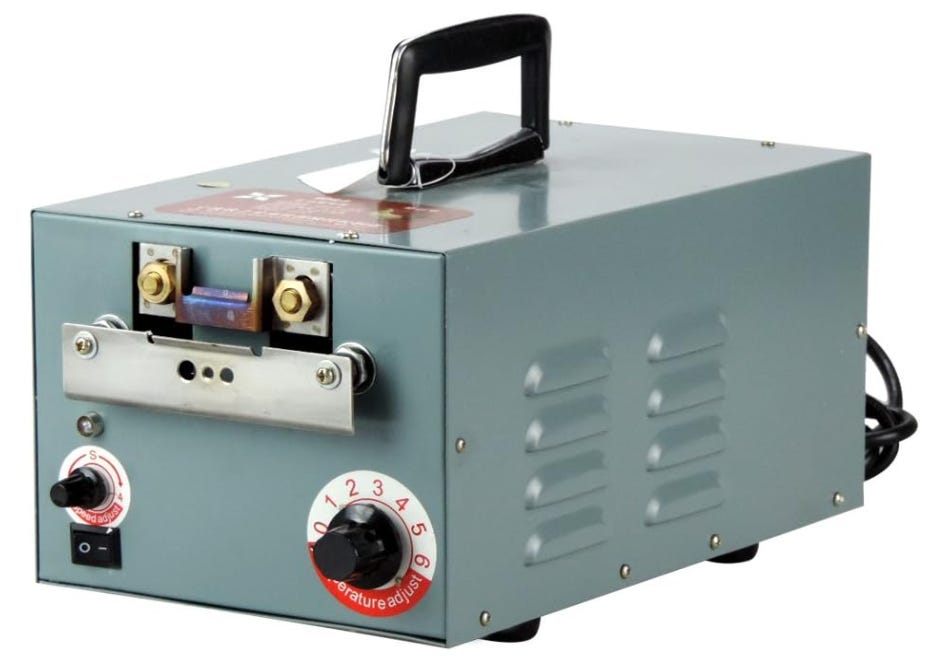
Wallace likens the question of the necessity of boiling lobsters alive—or, more precisely, how little the necessity is questioned—to other industry-standard and morally dubious practices in animal agriculture, namely chicken debeaking, dehorning cattle in commercial feedlots, and “cropping swine’s tails in factory hog farms to keep psychotically bored neighbors from chewing them off.” The almost comically brutal procedure that is chicken debeaking, involves (brace!) the placing of chicks’ faces into what, if you squint hard enough, resembles a car battery, and the subsequent chopping of a farmer-adjustable portion of their beaks with a sharp blade or an infrared laser (exhale). (A listing on Amazon for $119.99—with Prime shipping, no less!—advertises self-cauterizing capabilities to stop the bleeding incurred by the initial cut. Cut the beak and stop bleeding! it proclaims.)
Debeaking is common practice not because chickens’ beaks as they are provide them with any discomfort or pose a danger to their health (as does a domesticated dog’s dewclaw or a domesticated sheep’s wool), but because the conditions in which chickens are kept in commercial agriculture, in their pens and in transport trucks, are often so frantically crowded that chickens will routinely peck one another to death.
It is easy to attribute a practice as grotesque as debeaking to psychopathic cruelty, or as yet another example of the disregard our species shows to other-than-human life. I venture, however, that it is not psychopathy, cruelty, or callous disregard that leads a man2 to use a chicken de-beaker. It’s desperation.
I posit that the first man3 who felt the need to hold his chickens down and manually debeak them (these things weren’t always automated) so that they wouldn’t kill each other in their confinement at the very least regretted the circumstances that led him to that point. I would like to think he even felt bad about it. More likely than not, this man debeaked his chickens not out of contempt for their existence, but because he had a mortgage. This man took a gamble, put down a big wad of cash, and signed for a payment plan on a farm, knowing that if it didn’t produce that it would all be taken away. He likely took out loans to pay for chickens, feed, and the necessary equipment to sustain the scale of operation that would both support his family and pay off his loans. This man found, eventually, that to produce the quantity of birds needed to turn enough profit to stay viable in the market, he had to pack his (perhaps beloved) birds into crammed trucks and pens.
In his mind, his family was on the line when he made these decisions. Obviously, if he felt he could simply keep fewer birds on a larger parcel of land and live comfortably, he would have done so. You can imagine his dismay when he finds half his poultry stock dead to a panicked sharp-beaked brawl. If he felt that he could feasibly adjust his operation to keep the chickens comfortable, he would not have done what he did next. He would have simply grieved the suffering he inadvertently inflicted on the chickens and scaled down to allow them enough space for comfort. Instead, he calculates that he must continue his operation at its current capacity if he wants to feed his family and keep his farm. He then looks for ways to keep chickens from pecking each other to death, short of economically-infeasible options such as giving them enough space to exist semi-comfortably, of course. Thus, he arrives at the debeaker.
I’m sure the first few times he puts it to use are all flinches and grimaces. I’m sure he is, on some level, haunted by it. But if his conscience raises questions about the morality of the procedure, his intellect raises no dispute to its economic necessity.
David Graeber, in Debt: The First 5,000 Years, describes the type of panicked desperation that is characteristic of debt, the feeling the one needs desperately to turn everything around them into money if they are to evade their creditors. Graeber argues that some of history’s worst atrocities were not born of hatred per se, but rather by a need to create value that was so urgent that people felt that a horrific act of violence was the only way to do it.4
Our farmer, flanked by his precarious position in a market dominated by massive animal ag. conglomerates and his more-than-likely debt to a bank keen on collecting, reasons that he simply cannot afford to scale down his farm or modify his operation to sufficiently reduce the stress on the birds. Most importantly, he cannot afford to keep losing his merchandise. He has loans to repay, a family to feed, and a market to compete in. Hence, the debeaker. $119.99 on Amazon. A sensible investment for any economically-minded farmer.
a.k.a “beak-trimming” or “beak conditioning”.
That chicken debeakers are mostly used by men seems a safe enough guess.
As before, this assumption seems safe.
e.g., Graeber cites evidence that the conquistador Hernán Cortés was in perpetual debt to Spanish creditors, and was empowered by the Spanish crown and his creditors alike to loot and pillage Latin America to obtain the gold he needed to pay them back.